
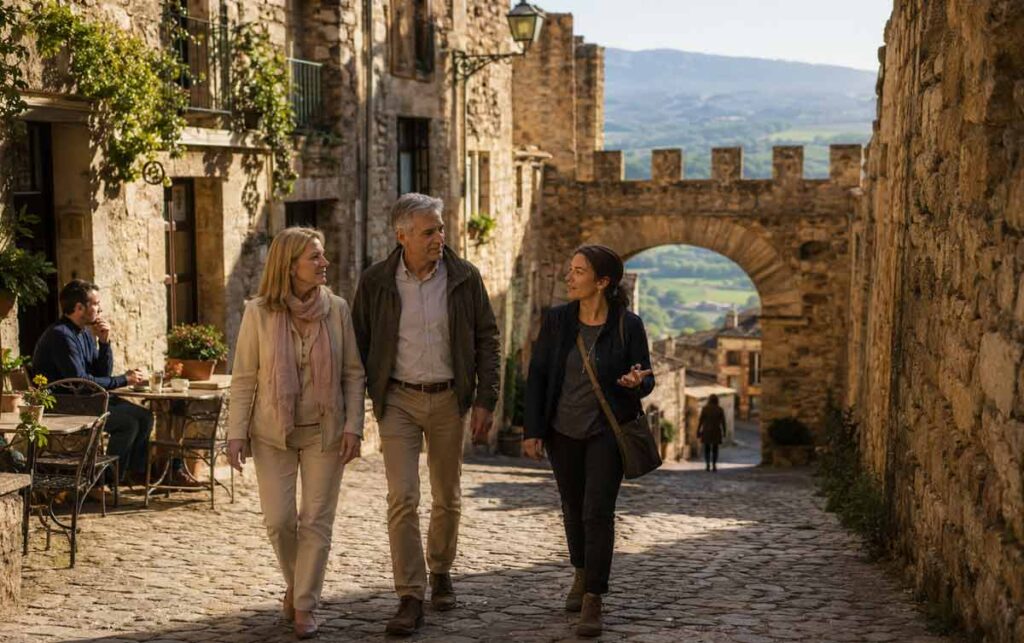
15 Best Medieval Towns and Villages in Spain for Slow Travel
Spain’s medieval past is easy to find. Experiencing it without rushing is another matter.
Beyond Madrid, Barcelona and Seville, there is a quieter Spain of fortified hill towns, stone villages, castle walls, old squares and roads that wind through vineyards, canyons and mountain landscapes.
Some places reward a relaxed two-hour walk. Others deserve half a day, a long lunch or even an overnight stay. And that difference matters when you want to enjoy the journey rather than simply collect destinations.
In this guide, we have selected 15 of the best medieval towns and villages in Spain for travelers who value history, local culture, beautiful scenery and a comfortable pace.
You will also discover which places work best for food and wine, gentle adventure, quieter streets or longer private routes.
The idea is simple: help you choose the places that genuinely fit the way you want to travel.
Prefer to explore Spain without managing every drive, reservation and stop yourself? Rutica41 creates private journeys for travelers who want more time to enjoy the places they visit and less time worrying about logistics.
15 Best Medieval Towns and Villages in Spain at a Glance
If you are still deciding where to go, start here. These 15 destinations offer very different versions of medieval Spain, from fortified towns and Pyrenean villages to wine country, mountain landscapes and quiet stone streets.
| Destination | Region | Best for |
|---|---|---|
| Albarracín | Aragón | Atmosphere and architecture |
| Alquézar | Aragón | History and canyon scenery |
| Aínsa | Aragón | Pyrenees and stone heritage |
| Daroca | Aragón | Walls and quieter discovery |
| Teruel | Aragón | Medieval and Mudéjar heritage |
| Sos del Rey Católico | Aragón | Fortified medieval character |
| Laguardia | Basque Country | Wine and history |
| Olite | Navarra | Palaces and architecture |
| Hondarribia | Basque Country | Walls, food and sea views |
| Santillana del Mar | Cantabria | Classic medieval atmosphere |
| Potes | Cantabria | Mountains and local food |
| Besalú | Catalonia | Iconic medieval heritage |
| Peratallada | Catalonia | Slow travel |
| Pals | Catalonia | Stone streets and countryside |
| Pedraza | Castile and León | Walled-town charm |
Aragón appears prominently for a reason. Few regions in Spain combine medieval heritage, dramatic landscapes, historic towns and quieter travel so naturally.
It is also where Rutica41 has its strongest local knowledge, which allows us to go much deeper than simply listing beautiful places.
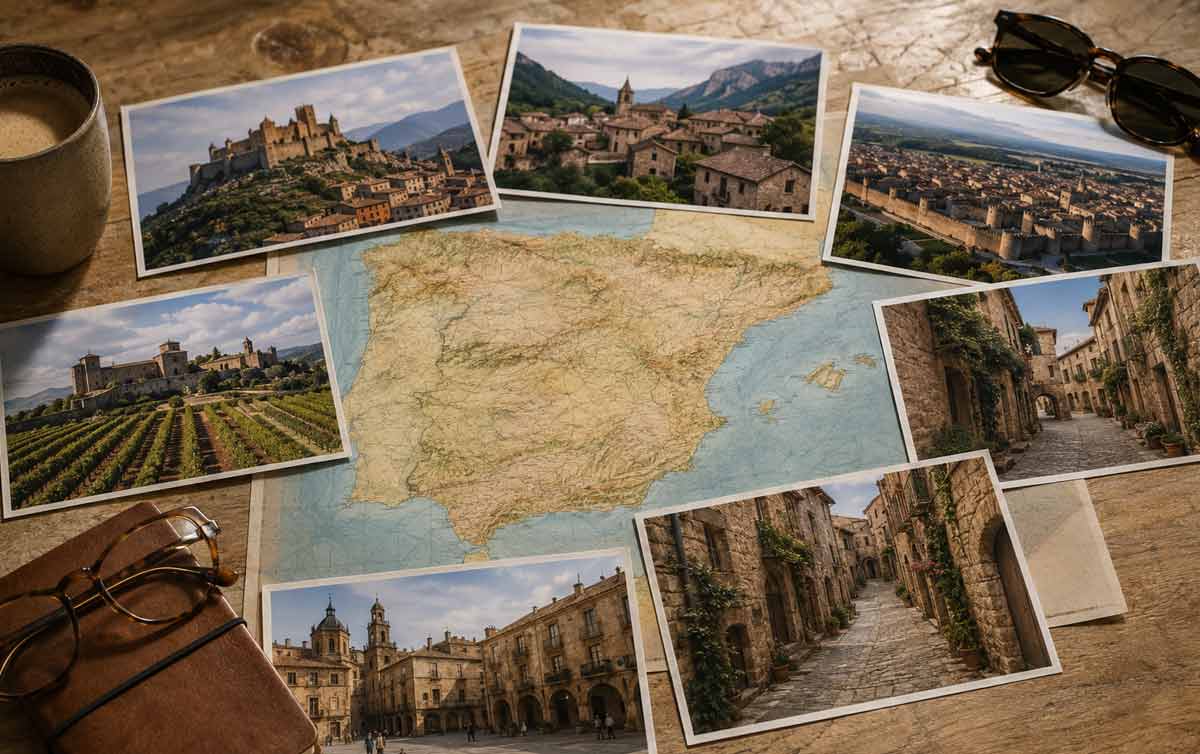
Further north and east, the character changes: vineyards around Laguardia, Atlantic scenery in Hondarribia, mountain landscapes around Potes and beautifully preserved stone villages in Catalonia.
The sections ahead will help you understand which of these places best matches your interests, walking pace and available time.
Why Spain Is Perfect for Medieval Towns, Slow Travel and Quiet Discovery
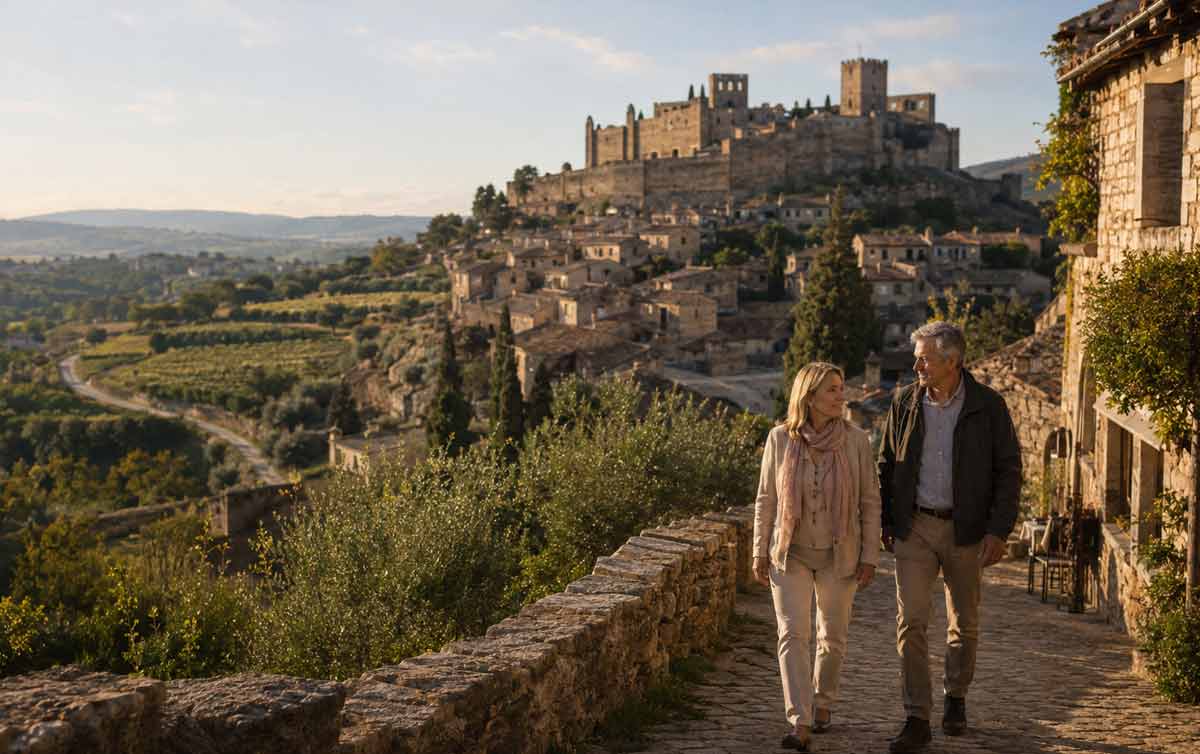
Spain’s medieval towns are not simply places to photograph and move on from. The best ones invite you to slow down, walk without a strict schedule and notice the details that disappear when a trip is reduced to a checklist.
That is one of the reasons these towns work so well for travelers who want culture, local character and discovery without spending every day rushing between major attractions.
This slower way of exploring medieval Spain gives you more room for:
- Historic towns and stone villages with walls, castles and old quarters that can be explored at your own pace.
- Local food and wine instead of treating lunch as something to fit between attractions.
- Quieter roads and countryside that make the journey between destinations part of the experience.
- Gentle adventure, from viewpoints and defensive walls to canyons, wine cellars and optional scenic walks.
Medieval Towns, Stone Villages and Historic Old Quarters
Medieval Spain comes in many forms. Some places are compact stone villages built around a castle or church. Others are fortified towns protected by walls and gates, while larger historic cities still preserve medieval quarters inside a more modern setting.
For broader historical context, the history of Spain in the Middle Ages helps explain why the country contains such a varied collection of fortified settlements, historic centers and architectural traditions.
This variety is part of the appeal. Albarracín feels completely different from Hondarribia, just as a Pyrenean town such as Aínsa offers a very different experience from the vineyards surrounding Laguardia.
Culture, Local Food and Countryside Without Rushing
A slower journey also leaves room for the things that often become the best memories: sitting down for lunch instead of grabbing something quickly, trying regional wine, stopping at a viewpoint or spending another half hour in a quiet square simply because you want to.
Between the towns, the landscape matters too. Vineyards, canyons, mountain roads and open countryside turn the drive itself into part of the experience.
Quiet Discovery Away From Spain’s Busiest Tourist Routes
Not every medieval town in Spain is undiscovered, and some of the most beautiful can become busy at certain times of year.
But traveling beyond the country’s major tourism circuits gives you more opportunities to find smaller places, quieter streets and a stronger sense of local life.
Choosing the right destination — and often the right time of day — can make a remarkable difference.
Gentle Adventure Without Turning the Trip Into an Expedition
Adventure does not have to mean a demanding hike. It might be walking along old defensive walls, climbing to a castle viewpoint, exploring a canyon landscape, visiting an underground wine cellar or adding a short scenic walk to the day.
This type of exploration fits naturally within the broader idea of the Middle Ages, whose surviving architecture and fortified landscapes still shape many of the places travelers can experience in Spain today.
The key is choice. The best route is not the most physically demanding one, but the one that gives you enough discovery to feel exciting while still leaving time to enjoy where you are.
How We Chose the Best Medieval Towns in Spain
Choosing the best medieval towns in Spain is not simply a matter of finding the places with the oldest walls or the most impressive photograph.
For this guide, we have looked at the experience as a whole: the historic character of each destination, what there is to discover beyond one famous monument, how enjoyable it is to explore on foot, the surrounding landscape and whether the town still gives you enough space to slow down and actually take it in.
In practical terms, we have paid particular attention to:
- Authentic medieval character through walls, castles, old quarters, fortified entrances and historic urban layouts.
- Walking conditions, including cobblestones, slopes, stairs and the overall effort required to explore comfortably.
- Local atmosphere and whether the town still feels lived in rather than functioning only as a tourist attraction.
- Food, wine and regional culture that can add depth to the visit.
- Natural surroundings and scenic routes that make the journey between destinations part of the experience.
- Crowd levels and travel pace, especially for travelers who prefer quieter and more personal experiences.
Authentic Medieval Character, Not Just a Pretty Photograph
A beautiful stone street is a good start, but it is not enough on its own. The towns in this guide have a stronger sense of historical continuity through their walls, castles, old quarters, fortified entrances, squares or traditional urban layout.
The goal is to find places where the medieval character shapes the experience rather than appearing as a single isolated landmark.
A Rewarding Visit Beyond One Famous Landmark
The strongest destinations give you reasons to stay after seeing the main attraction. That might mean walking through a historic quarter, stopping for lunch, discovering a viewpoint, entering a church or castle, or simply spending time in a square where the town still feels lived in.
A memorable visit should feel like more than arriving, taking the photograph and leaving again. The best places invite you to spend time rather than simply pass through.
Walking Conditions and the Possibility of Exploring at a Comfortable Pace
Medieval towns were not designed for modern travelers. Cobbled streets, slopes, stairs and pedestrian-only historic centers are part of their character, and the experience can vary considerably from one destination to another.
That is why walking conditions matter in this guide. We will point out where a visit is relatively compact, where steeper streets should be expected and where an optional activity may require more effort than exploring the town itself.
Local Atmosphere and Fewer Signs of Mass Tourism
Some famous medieval towns are popular for good reason, and we have not excluded a place simply because other travelers have discovered it. But popularity is not the only measure of quality.
We have also given weight to towns where the pace feels calmer, local life remains visible and the experience can still feel personal when you choose the right destination and the right time to visit.
Good Connections With Food, Nature and Scenic Routes
The town itself matters, but so does what surrounds it. A medieval stop becomes much more rewarding when it can be paired naturally with regional food, vineyards, mountain scenery, a canyon, a scenic road or another historic destination without spending most of the day in transit.
That wider travel experience is one of the reasons Aragón plays such an important role in this list.
Why Aragón Is One of Spain’s Best Regions for Medieval Towns
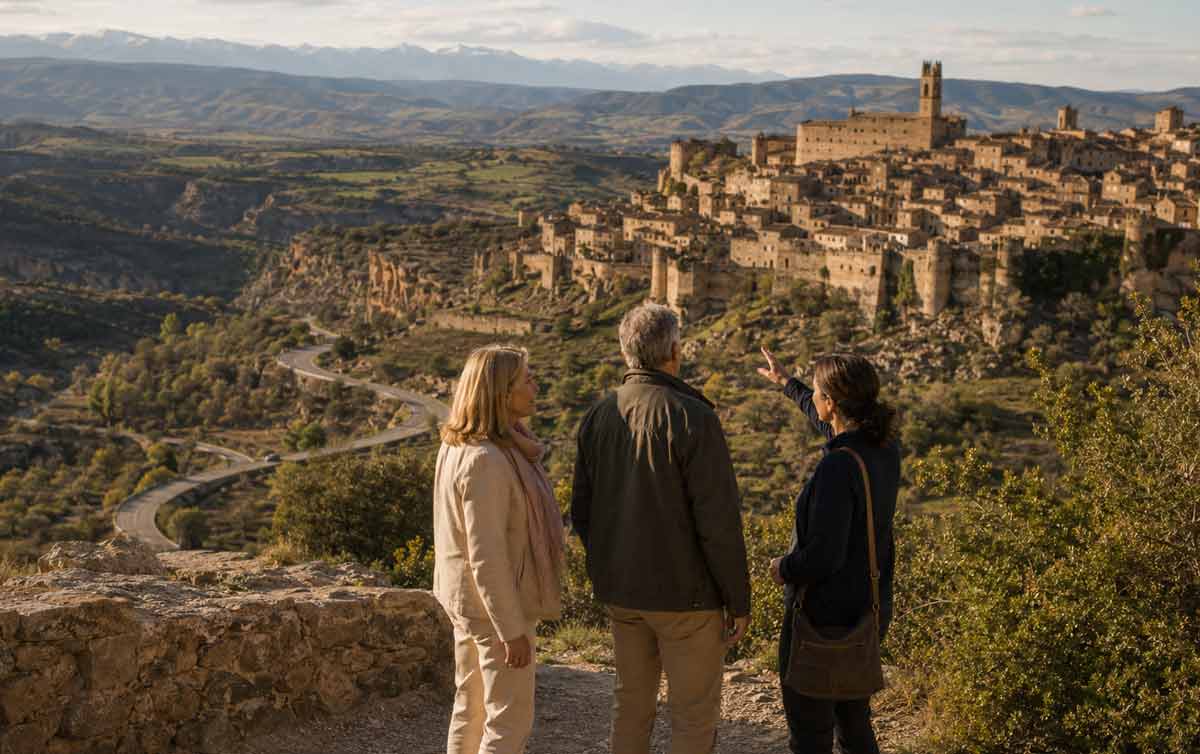
Aragón is not included so prominently simply because Rutica41 is based in Zaragoza. It earns its place because the region brings together several very different versions of historic and medieval Spain within the same broad territory.
You can move from fortified towns and Mudéjar heritage to Pyrenean villages, canyon landscapes and quiet inland roads without feeling that every stop is offering the same experience.
Zaragoza as a Useful Starting Point for Exploring Aragón
Zaragoza provides a practical base for discovering many of the region’s historic destinations.
From here, a day can be built around one important town rather than trying to squeeze several places into an unrealistic schedule, while longer routes can connect different parts of Aragón at a more relaxed pace.
The important point is not how many stops can fit on a map. It is how much time you actually have to enjoy each one.
Medieval Towns, Pyrenean Villages and Dramatic Landscapes
One of Aragón’s strengths is variety. Albarracín offers a completely different atmosphere from Alquézar, while Aínsa brings the Spanish Pyrenees into the journey and Daroca adds the character of a quieter fortified town.
Teruel introduces another layer through its medieval and Mudéjar heritage, while Sos del Rey Católico brings a remarkably preserved fortified setting in the province of Zaragoza.
That contrast makes it possible to build a journey around history, landscape, food and local character rather than architecture alone.
🏰 Love medieval castles? Aragón has another remarkable historic stop worth considering. Discover what makes Loarre Castle one of the region’s most interesting medieval experiences.
A Different Side of Spain for Travelers Who Prefer Fewer Crowds
For travelers who already know Spain’s major cities — or simply want a different experience from the busiest tourism circuits — Aragón offers another rhythm.
This does not mean every street will be empty. Albarracín and Alquézar, for example, can be popular.
But the region also provides opportunities to travel through smaller places, open landscapes and historic towns where the experience can feel considerably less rushed.
Why Local Route Knowledge Matters Here
Distances that look short on a map do not always translate into a good day of travel. Historic-center access, parking, restaurant hours, mountain roads and walking time can change how two seemingly similar routes actually feel.
This is where local route knowledge becomes useful: not to add more stops, but to remove unnecessary friction and create enough space for the places themselves.
If Aragón is likely to become an important part of your journey, you can also explore our private cultural tours in Spain, where history, local culture and slower-paced travel are developed in greater depth.
Best Medieval Towns and Villages in Aragón
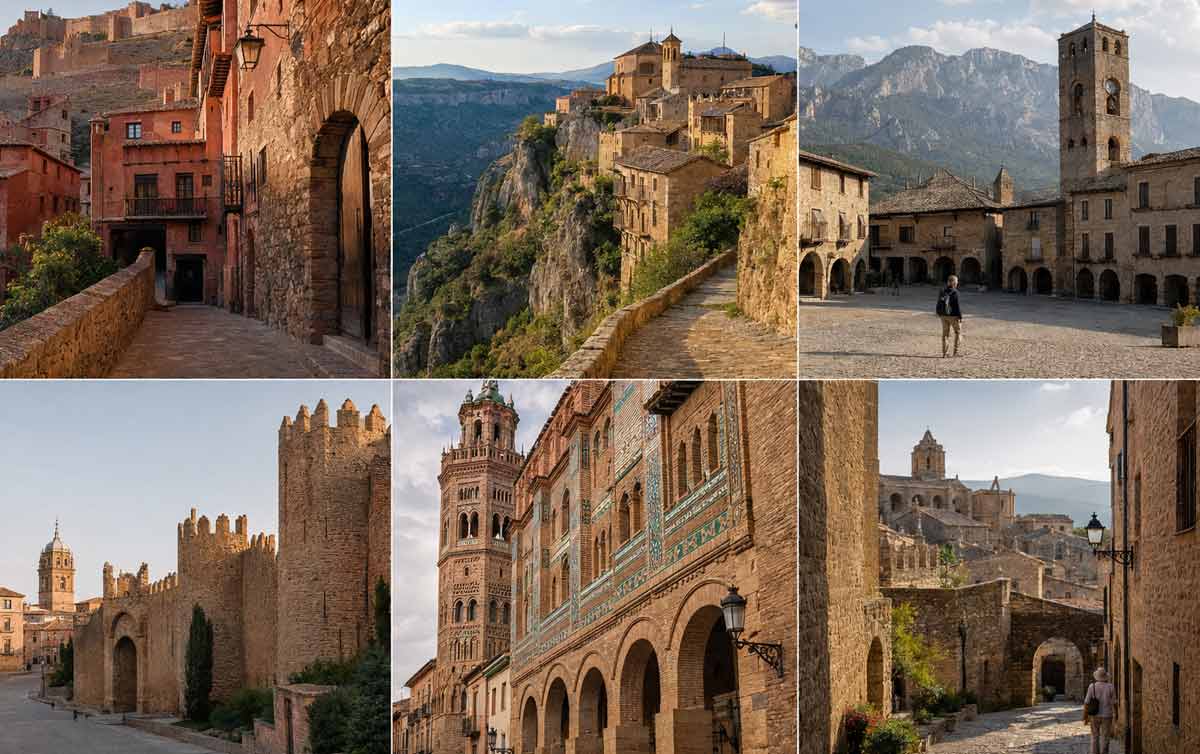
If you want to understand why Aragón deserves more than a quick stop on a trip through Spain, these three places are a good place to begin.
Albarracín, Alquézar and Aínsa share medieval character, but they do not offer the same experience.
One is defined by reddish houses and steep fortified streets, another combines a medieval village with a dramatic canyon, and the third opens the door to the landscapes of the Spanish Pyrenees.
That variety is precisely what makes this part of Spain so rewarding for travelers who prefer to combine history, scenery and time to explore without rushing.
1. Albarracín: One of Spain’s Most Beautiful Medieval Towns
Albarracín is the kind of place that makes you slow down before anyone has to tell you to.
Set above a bend of the Guadalaviar River in the province of Teruel, its historic center preserves an unusual combination of Islamic and medieval heritage, fortified walls, narrow lanes and reddish-toned houses that seem to follow the shape of the rocky hillside rather than any modern idea of urban planning.
Albarracín was once the capital of a taifa kingdom, and that history still helps explain the character of the settlement.
The fortified enclosure rises well beyond the compact historic center, creating some of the town’s most recognizable views.
But Albarracín is better experienced from street level than from a list of monuments. Walk through the old quarter, look up at the wooden balconies and irregular façades, pass through small squares and allow time for the town to reveal itself gradually.
Plaza Mayor provides a natural pause in the middle of the visit, while the cathedral, the Episcopal Palace and the surviving defensive structures add historical context.
If you want broader views, sections around the walls and higher viewpoints reveal how dramatically the town sits within the landscape.
There is one practical point worth knowing before you arrive: Albarracín involves slopes, cobblestones and uneven streets. Exploring the historic center does not require a serious hike, but this is not a flat town.
The climb toward the walls adds another level of effort and should be treated as optional rather than essential to enjoying the destination.
For a relaxed visit, Albarracín works much better when you resist the temptation to rush through it. Give yourself time for the old quarter, a few viewpoints and a proper lunch rather than trying to turn it into another photo stop.
🏰 Explore Albarracín in more depth: Planning to spend more time here? Discover the walls, viewpoints, local food and practical ideas in our complete guide to what to do in Albarracín.
Best for: travelers who put medieval atmosphere, architecture and historic character at the top of their list.
2. Alquézar: Medieval Streets, Canyon Views and Gentle Adventure
Alquézar offers something different. Here, medieval heritage and nature are almost impossible to separate.
The village sits in the province of Huesca, in the foothills of the Pyrenees and within the Sierra y Cañones de Guara Natural Park.
Above its stone streets stands the Castle-Collegiate Church of Santa María la Mayor, built on the site of an earlier defensive stronghold and still dominating the village from its rocky position.
The historic center is compact enough to invite wandering. Narrow streets, covered passageways, stone houses and small squares climb toward the collegiate church, while viewpoints reveal the limestone landscape and the Vero River canyon below.
That setting is what makes Alquézar particularly interesting for travelers who want to introduce a little gentle adventure into a cultural journey.
The best-known option is the Pasarelas del Vero, a circular walking route that descends from Alquézar into the canyon and follows sections of walkway above the river.
The official short route is approximately 2.2 kilometers, with around 160 meters of elevation change and an estimated walking time of about 90 minutes.
Those numbers can make it sound easier than it feels. There are descents, steps and a climb back toward the village, so it should be considered an optional addition, not something every visitor needs to do.
If you prefer a gentler day, you can enjoy Alquézar through its streets, viewpoints and historic buildings without entering the canyon at all.
That flexibility is important: you can decide how much activity to add rather than allowing the activity to define the entire visit.
Alquézar also sits within the wider Somontano area, making it particularly appealing when a route combines medieval heritage, landscape, local food and wine.
Best for: travelers who want history and beautiful scenery with the option of adding an active experience.
3. Aínsa: A Stone Medieval Town in the Spanish Pyrenees
Aínsa changes the mood again.
Instead of a town enclosed by a dramatic river bend or perched above a canyon, Aínsa introduces you to the mountain landscapes of the Spanish Pyrenees while preserving one of Aragón’s most recognizable historic centers.
The heart of the visit is its broad Plaza Mayor, surrounded by traditional stone buildings and arcades. From there, the old streets lead toward the Church of Santa María and the large castle enclosure that marks one end of the medieval center.
The contrast is part of Aínsa’s appeal. The historic quarter feels compact and coherent, but the surrounding views remind you that you are entering a much larger landscape of valleys, rivers and mountains.
For travelers who like history but do not want every day to revolve around monuments, that makes Aínsa particularly useful. You can spend time exploring the medieval center, stop for a leisurely meal and then continue into the countryside without needing to turn the day into a demanding mountain excursion.
Aínsa is also well positioned for exploring the wider Sobrarbe area and the landscapes associated with the Aragonese Pyrenees.
Ordesa y Monte Perdido National Park lies within the broader region, giving travelers the possibility of combining a medieval town with mountain scenery on a longer itinerary.
The old town still involves stone paving and some changes in level, but the experience is different from climbing the steeper streets of Albarracín or completing the canyon route in Alquézar. As always with medieval destinations, the exact walking plan should depend on how much time and physical effort you want to build into the day.
There is another reason not to rush Aínsa: food and atmosphere are part of the experience. A long lunch around the historic center can make more sense than squeezing another distant town into the afternoon.
Best for: travelers who want to combine medieval streets, Pyrenean scenery and a more relaxed introduction to mountain Spain.
Albarracín, Alquézar or Aínsa: Which One Should You Choose?
- Choose Albarracín if medieval atmosphere, architecture and dramatic historic streets are your priority.
- Choose Alquézar if you want to combine a medieval village with canyon scenery and the option of a more active walk.
- Choose Aínsa if you want medieval heritage together with Pyrenean landscapes and a route that can continue deeper into northern Aragón.
If your itinerary allows it, the better question may not be which one to visit, but how to combine them without spending too much of the journey in the car.
That is where the order of the route, your available days and the pace you prefer become more important than simply adding more destinations.
4. Daroca: A Quiet Walled Medieval Town in Aragón
Daroca is easy to overlook when travelers start making a list of the best medieval towns in Spain. That is also part of its appeal.
Located south of Zaragoza in the Jiloca valley, Daroca developed as an important fortified town, and its historic center is still framed by an extraordinary defensive system of walls, towers and gateways.
The surviving fortifications extend for more than four kilometers around the town. You do not need to walk the entire circuit to understand their scale.
Even from the historic center, the walls climbing the surrounding hills make it clear that Daroca was built with defense very much in mind.
For most visitors, Puerta Baja provides one of the most memorable entrances. From there, the town opens into a historic center of churches, old houses, narrow streets and architectural details that reveal different periods of Aragón’s past.
Daroca also offers something increasingly valuable on a trip through Spain: space to look around without feeling that the entire town has been organized around tourism.
It does not have the immediate visual drama of Albarracín or the mountain backdrop of Aínsa. Instead, its appeal builds more slowly. Walk through the old streets, notice the towers above you, look back toward the defensive walls and allow time for the town’s scale to make sense.
Several churches and historic buildings also reflect Aragón’s mixture of Christian medieval architecture and Mudéjar influences.
This gives Daroca another layer of interest for travelers who want to understand how different cultural traditions shaped the region rather than simply seeing another castle.
Walking conditions vary. The central part of town is relatively straightforward to explore, but reaching higher sections of the defensive system involves slopes and more demanding walking. There is no need to climb every hill to have a rewarding visit.
That makes Daroca particularly suitable for a flexible day: explore the historic center at a comfortable pace, choose how far you want to follow the fortifications and leave enough time for lunch rather than treating the walls as another challenge to complete.
Best for: travelers looking for a quieter fortified town, substantial medieval defenses and a more local atmosphere away from Spain’s most obvious historic destinations.
5. Teruel: A Historic City With Medieval and Mudéjar Heritage
Teruel needs a small clarification before we continue: it is a city, not a medieval village.
But leaving it out of a journey through medieval Aragón would mean missing one of the region’s most distinctive architectural stories.
Teruel is the provincial capital and is particularly known for its Mudéjar architecture, where medieval Christian building traditions incorporated decorative techniques and influences rooted in Islamic art.
This is what gives the historic center such a different visual identity from places like Albarracín or Sos del Rey Católico. Instead of stone walls defining the entire experience, Teruel draws your attention upward toward brick towers, glazed ceramics and geometric decoration.
Among the essential landmarks are the towers of El Salvador and San Martín, the Church of San Pedro and the Cathedral of Santa María de Mediavilla. Elements of Teruel’s Mudéjar architecture form part of UNESCO’s World Heritage designation for Mudéjar Architecture of Aragón.
The advantage for travelers is that many of these sights sit within a historic center that can be explored gradually on foot.
You can move between towers and squares, stop around the Plaza del Torico and build the visit around architecture rather than following a rigid monument-by-monument schedule.
Teruel also changes the rhythm of a medieval route because it feels more urban. There are more choices for cafés, restaurants and places to pause, which can be useful if you want a cultural day without spending every hour walking through steep village streets.
The city is also associated with the story of the Lovers of Teruel, whose tradition adds another cultural layer to the visit. It is worth approaching this as part of Teruel’s identity rather than allowing it to overshadow the architecture that makes the city especially relevant to this route.
From a practical point of view, Teruel can work particularly well as a complement to smaller medieval destinations. After narrow lanes and fortified hill towns, the city gives you a different interpretation of medieval Aragón while still keeping history at the center of the day.
It also pairs naturally with Albarracín when the itinerary allows enough time. The mistake would be to reduce both destinations to a rushed checklist simply because they can appear close enough on a map.
🕌 Going deeper into Teruel: If its Mudéjar architecture has caught your attention, explore the monuments, local culture and food in our guide to what to do in Teruel.
Best for: travelers interested in architecture, Mudéjar heritage and a historic city experience with more opportunities to pause for food and local life.
6. Sos del Rey Católico: A Fortified Medieval Town in Aragón
If Daroca feels expansive and defensive, Sos del Rey Católico feels more compact and enclosed.
Set on elevated rocky ground in the Cinco Villas area of Zaragoza province, Sos del Rey Católico preserves the atmosphere of a historic frontier town where stone streets, gateways and tightly grouped buildings still create a remarkably coherent setting.
Its location mattered. Sos developed as a fortified settlement in a territory where political boundaries shifted repeatedly during the Middle Ages. Today, that defensive character is still visible in the way the town occupies the hill and in the structure of its historic center.
Walking here is less about moving from one spectacular monument to another and more about allowing the streets themselves to become the experience.
Stone houses, arched passages, small squares and old entrances create a sense of continuity that is difficult to reproduce in a more heavily modernized town. Places such as the Plaza de la Villa, the medieval center and the area around the church and castle help reveal how compact the original settlement was.
Sos also has an important connection with Spanish history. Ferdinand II of Aragón, Ferdinand the Catholic, was born here in 1452. The Palacio de Sada is traditionally associated with his birthplace, and that episode eventually became part of the town’s name and identity.
But you do not need to arrive with a detailed knowledge of medieval politics to enjoy Sos.
Its real strength for the traveler is atmosphere. This is a place where it makes sense to walk slowly, turn down smaller streets and look back at the stone façades and surrounding landscape rather than concentrating only on famous landmarks.
The terrain is worth considering. Sos sits on a hill, so you should expect cobbled surfaces, slopes and changes in level. The historic center is compact, which helps, but comfortable shoes and an unhurried schedule make the experience considerably better.
Sos is also well placed for travelers interested in the broader character of Cinco Villas, an area where several historic settlements can be connected as part of a longer route. Again, the goal should not be to fit every possible village into one day. Giving one or two places enough time usually produces a much more rewarding experience.
Best for: travelers who want a highly atmospheric fortified town, strong medieval character and an important connection with the history of Aragón.
Daroca, Teruel or Sos del Rey Católico: What Kind of Experience Do You Want?
- Choose Daroca if you are especially interested in defensive walls, fortified landscapes and discovering a historic town that receives less international attention.
- Choose Teruel if architecture is the priority and you want to understand Aragón’s distinctive medieval and Mudéjar heritage.
- Choose Sos del Rey Católico if you prefer a compact fortified town with stone streets, historic atmosphere and a direct connection with Ferdinand the Catholic.
- Combine several of them only when the route and available time make sense. More medieval towns do not automatically make a better day.
Not sure which medieval town fits your pace and interests?
Aragón gives you plenty of choices, but the best route depends on more than a list of beautiful places. Walking preferences, driving time, lunch stops, scenery and how much you actually want to see in one day all matter. Rutica41 can help you build a private journey around the places that genuinely suit the way you want to travel.
Best Medieval Towns in Northern Spain
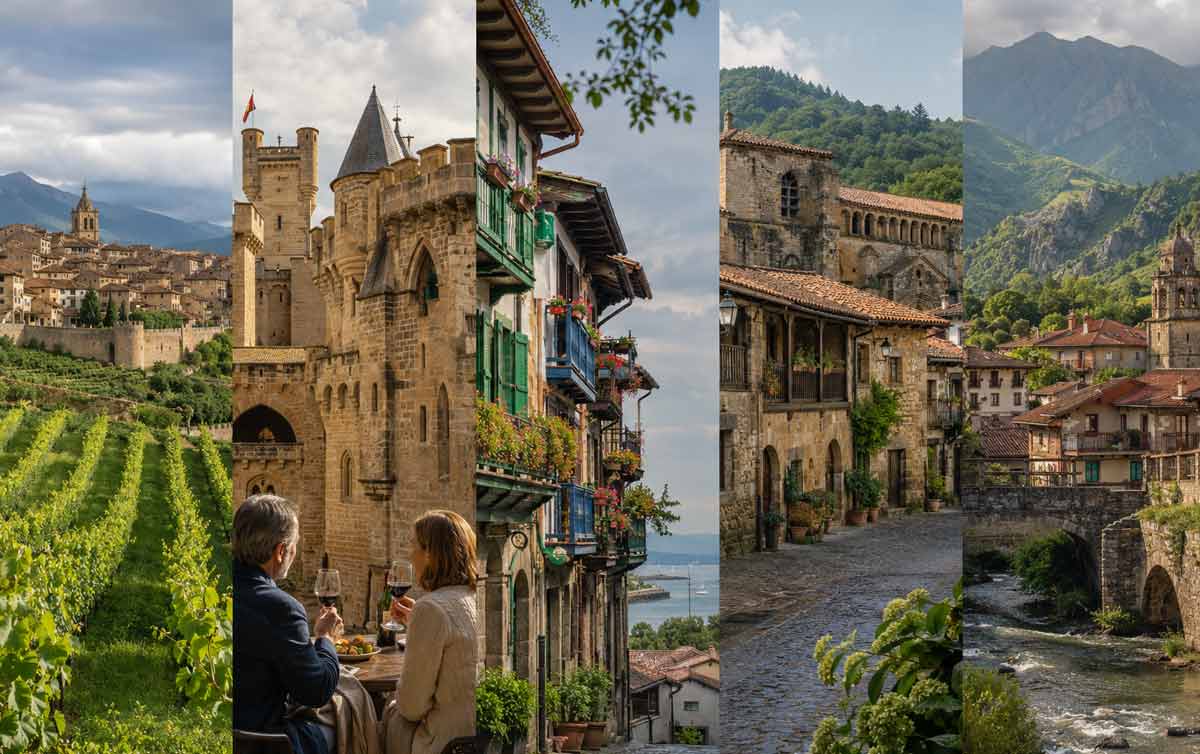
Northern Spain changes the character of the journey. Here, medieval streets can lead to vineyards, Atlantic coastline, green valleys and mountain landscapes, giving you much more than historic architecture alone.
The five destinations below are especially useful if you want to combine medieval heritage with food, wine and scenery. They are also very different from one another, which makes choosing the right one more important than trying to fit all of them into the same trip.
7. Laguardia: A Medieval Wine Town Surrounded by Vineyards
Few places combine medieval character and wine culture as naturally as Laguardia.
Set on a hill in Rioja Alavesa, in the Basque Country, Laguardia is surrounded by vineyards and enclosed by defensive walls whose origins go back to the Middle Ages.
Once you pass through the historic gates, the landscape disappears for a while and the experience becomes more intimate. Narrow streets, stone façades, small squares and historic buildings create a compact old town that is particularly enjoyable to explore without a strict schedule.
Among its most important landmarks is the Church of Santa María de los Reyes, but Laguardia works best when the visit is not reduced to individual monuments.
Part of its appeal is simply walking through the fortified center and then stepping outside to see how dramatically the town rises above the surrounding wine country.
And here, wine is not an optional theme added for tourists. Rioja Alavesa is one of Spain’s most important wine-producing areas, and vineyards and wineries shape much of the landscape and local identity.
That creates a very natural slow-travel day: explore the old town in the morning, make time for a winery or tasting if that interests you, and leave enough space for lunch rather than racing toward another distant destination.
Walking through the historic center is relatively compact, although you should still expect cobblestones and some changes in level typical of an old fortified settlement.
Best for: travelers who want medieval streets, wine culture and countryside to form part of the same experience.
8. Olite: A Medieval Palace Town in Navarra
Olite has one immediate advantage: you do not have to search very hard for its defining landmark.
The Royal Palace of Olite rises above the historic center with towers, courtyards, galleries and fortified walls that give the town one of the most recognizable medieval silhouettes in Navarra.
The palace became an important residence of the kings and queens of Navarre, particularly during the period of Charles III the Noble.
It underwent major transformations between the 13th and 15th centuries and remains the central reason many travelers first discover Olite.
But the town should not be treated simply as a castle stop.
Around the palace you will find stone streets, churches, squares and historic houses that make it worth spending time in the center after visiting the royal complex.
The Church of Santa María la Real, immediately beside the palace, is another important part of that historic setting.
Olite also works well for travelers who enjoy history but prefer a visit with a clear focal point. You can devote most of your cultural attention to the palace and then allow the rest of the day to unfold more casually through the streets, cafés and restaurants around town.
Navarra also gives Olite another advantage: it can become part of a broader route that combines castles, wine country, historic towns and rural landscapes rather than functioning as an isolated destination.
Inside the palace, expect stairs and towers if you want to explore more thoroughly. You do not need to climb every possible section, however, to appreciate the architecture and atmosphere.
Best for: travelers who want an impressive medieval palace to be the centerpiece of the visit.
9. Hondarribia: Medieval Walls, Colorful Streets and Sea Views
Hondarribia proves that a medieval route through Spain does not have to stay inland.
Standing close to the French border at the mouth of the Bidasoa River, this Basque town combines a walled historic center with Atlantic scenery and a strong food culture.
The old town is the place to begin. Behind its defensive walls, cobbled streets lead past historic houses and aristocratic buildings toward the Plaza de Armas and the Castle of Charles V, which occupies a strategic position in the upper part of the historic quarter.
But then Hondarribia changes personality.
Leave the fortified center and you can move toward the traditional maritime area, where colorful façades and restaurants create an entirely different atmosphere.
That contrast between medieval stone, Basque architecture and the sea is what makes Hondarribia stand apart from almost every other destination in this guide.
Food is another reason not to rush. The Basque Country has one of Spain’s strongest culinary identities, and Hondarribia is a good place to leave time for pintxos, seafood and a proper lunch instead of designing the day around sightseeing alone.
The historic center includes cobbled surfaces and changes in level, but the visit can be adapted. There is no need to turn every viewpoint or surrounding hill into part of the walking route.
Hondarribia can also fit naturally into a longer northern Spain journey involving San Sebastián, the Basque coast or the nearby French border.
Best for: travelers who want medieval heritage without giving up coastal scenery and memorable food.
10. Santillana del Mar: A Classic Medieval Village in Northern Spain
Santillana del Mar is one of those places where the reputation arrives before you do.
This historic Cantabrian town developed around the Collegiate Church of Santa Juliana, and its old center preserves a remarkably coherent collection of cobbled streets, stone houses, defensive towers and later Renaissance palaces.
The collegiate church remains the architectural heart of the visit. Its present Romanesque structure largely dates from the 12th century, and its cloister, sculptural details and medieval character make it much more than a picturesque backdrop.
From there, the best approach is simply to walk.
Santillana does not need a complicated itinerary. Its pleasure comes from following the streets around the historic center, noticing façades and courtyards and allowing enough time to absorb a place that feels unusually complete.
There is, however, an important difference between Santillana and some of the quieter towns in this guide: it is a well-known tourism destination.
If atmosphere matters to you, timing can make a significant difference. An earlier start or a visit outside the busiest periods will usually fit the slow-travel experience better than arriving at the most obvious peak time.
The surrounding area also gives Santillana an unusual cultural advantage. Nearby is the Altamira Museum and Neocave, which introduces a completely different chapter of human history and can turn the destination into a much richer cultural day.
Best for: travelers looking for a classic and beautifully preserved historic town, especially when they can choose a quieter time to explore it.
11. Potes: A Mountain Town for Medieval Streets and Cantabrian Scenery
Potes deserves a slightly different label from some of the other destinations on this list.
It is better understood as a historic mountain town with important medieval heritage rather than a perfectly preserved medieval settlement frozen in one period. That distinction actually makes it more interesting.
Located in the historic region of Liébana, Potes sits among some of northern Spain’s most dramatic mountain scenery.
Its old streets, bridges and traditional buildings are dominated by the Torre del Infantado, a substantial 15th-century tower and one of the town’s most recognizable monuments.
The historic center is compact enough to explore without turning the day into a long walking challenge. Crossing the old bridges over the Quiviesa River, wandering through the streets and pausing around the central squares can easily form the cultural part of the visit.
But Potes becomes especially valuable when you look beyond the town itself.
This is the heart of Liébana and one of the natural gateways to the Picos de Europa. Mountain roads, valleys and viewpoints make the surrounding journey as important as the streets you have come to see.
That does not mean you need to hike. Potes works perfectly well as a base for travelers who simply want to experience mountain scenery, enjoy shorter stops and decide how much outdoor activity to add.
Food also deserves space in the itinerary. Local specialties include cocido lebaniego, regional cheeses and the traditional grape-based spirit known as orujo. This is exactly the kind of destination where a long lunch can be as memorable as another monument.
Best for: travelers who want historic streets, local food and dramatic mountain scenery in the same day.
If you are deciding between these five northern destinations, a simple way to choose is:
- Choose Laguardia for medieval atmosphere, vineyards and wine.
- Choose Olite when a spectacular royal palace is your main historical priority.
- Choose Hondarribia for fortified streets, Basque food and Atlantic scenery.
- Choose Santillana del Mar for one of northern Spain’s most complete classic historic-town experiences.
- Choose Potes for medieval heritage combined with Liébana, mountain landscapes and regional cuisine.
There is no single “best” choice among them. The right medieval town depends on what you want the rest of the day to feel like: wine country, a palace, the coast, a concentrated cultural visit or the mountains.
Medieval Villages in Catalonia and the Costa Brava
Catalonia offers another version of medieval Spain. Here, stone villages, Romanesque architecture and fortified streets sit surprisingly close to Mediterranean landscapes, vineyards and the countryside of Girona.
Besalú, Peratallada and Pals can all fit naturally into a wider journey through Catalonia, but each gives you a different reason to stop. One is defined by an extraordinary bridge and deep medieval history, another by intimate stone streets, and the third by elevated views over the Empordà countryside.
12. Besalú: Medieval Heritage Around One of Spain’s Most Recognizable Bridges
For many travelers, the first view of Besalú is enough to explain why the town belongs on a list of Spain’s best medieval destinations.
Its monumental Romanesque bridge across the Fluvià River, with its stone arches and fortified gateway, creates one of the most memorable entrances to any historic town in Catalonia.
But crossing the bridge should be the beginning of the visit, not the end of it.
Besalú was an important medieval center, and the old town still preserves a remarkably rich collection of religious and civil architecture.
Walking through its narrow streets leads you toward places such as the Church of Sant Vicenç, the former monastery of Sant Pere and the old Jewish quarter.
The town’s Jewish heritage adds particular depth. Besalú preserves the remains of a medieval synagogue complex and a historic mikveh, or Jewish ritual bath, providing another perspective on the communities that shaped medieval Catalonia.
This is one of those destinations where it pays to look beyond the obvious photograph. The bridge may bring you here, but the pleasure comes from walking slowly through the historic center, entering smaller streets and allowing enough time for the town’s different layers to emerge.
Besalú is compact, although cobbled surfaces and uneven sections are part of the experience. For most travelers, it works well as a relaxed half-day cultural stop rather than something to rush through in an hour.
Best for: travelers who want recognizable medieval architecture combined with a deeper historical story.
13. Peratallada: A Small Stone Village Made for Slow Travel
Peratallada does not need a dramatic skyline to make an impression. Its appeal is much more intimate.
Located in the Baix Empordà area of Girona, the village preserves an exceptionally atmospheric historic center shaped by stone houses, narrow lanes, arches, fortified walls and a castle complex.
This is a place where the streets themselves are the main attraction.
You can wander beneath stone passageways, turn into small squares and follow streets that seem to change character every few meters. The historic ensemble includes the castle-fortress, its keep and palace, while the Romanesque Church of Sant Esteve stands just outside the fortified center.
Peratallada works particularly well for slow travel because there is very little reason to hurry. There is no long checklist of major monuments demanding your attention. Instead, the pleasure comes from walking, stopping, looking at architectural details and leaving time for a drink or lunch.
That simplicity is part of what separates it from larger medieval destinations.
The stone paving can be uneven, so comfortable footwear still matters, but the historic center is relatively compact. You can explore without turning the visit into a demanding walking day.
Its location in the Empordà also makes Peratallada easy to understand as part of a broader journey rather than an isolated sightseeing stop. Medieval villages, agricultural landscapes and the Costa Brava can all form part of the same trip when the route is planned sensibly.
Best for: travelers who value atmosphere, quiet exploration and beautiful stone architecture more than a long list of monuments.
14. Pals: Medieval Streets and Countryside Views Near the Costa Brava
Pals gives you something the previous two villages do not: a medieval center combined with broad views across the Empordà countryside.
The historic quarter rises on a hill a few kilometers inland from the Costa Brava. As you walk upward through its stone streets, defensive remains, arches and historic houses gradually lead toward the higher part of the village.
One of the most recognizable landmarks is the Torre de les Hores, the surviving keep associated with the former castle. Nearby, the Church of Sant Pere and the Gothic character of the old quarter add to the sense that Pals is more than simply a picturesque viewpoint.
Still, those views matter.
From the elevated parts of town, the landscape opens over fields and plains toward the wider Empordà region. It is this connection between historic architecture and rural scenery that makes Pals particularly rewarding.
Food can also become part of the experience. The surrounding area is known for rice cultivation, and leaving time for a relaxed lunch provides a much more natural way to enjoy the destination than immediately driving to the next medieval village.
Pals can become busier during the high season, particularly because of its proximity to the Costa Brava. If quieter streets are important to you, the time of day and season can have as much impact as the itinerary itself.
Walking involves stone paving and some uphill sections, but the historic center is compact enough to explore gradually.
Best for: travelers who want medieval streets, elevated countryside views and easy connections with a wider Costa Brava journey.
A Medieval Town Worth Visiting Near Madrid
15. Pedraza: A Walled Medieval Town in Central Spain
After the mountains, vineyards and Mediterranean landscapes of the previous destinations, Pedraza brings the journey back to the heart of Castile.
Located in the province of Segovia, this walled historic town is particularly appealing for travelers who want to experience medieval and early modern Castilian architecture without building an entire itinerary around northern Spain or Aragón.
The experience begins at the Puerta de la Villa, the historic gateway into the town. From there, cobbled streets and traditional houses lead toward Pedraza’s broad Plaza Mayor, one of the most attractive historic squares in Castilla y León.
Continue through town and you eventually reach the castle, while the old prison near the entrance adds another layer to Pedraza’s history.
What makes Pedraza work especially well for slow travel is its manageable scale.
You do not need an ambitious sightseeing plan. A walk through the streets, time in the Plaza Mayor, the castle area and a long lunch can easily become the day.
That last part matters here. Pedraza has a strong tradition of Castilian cooking, making it a particularly good destination for travelers who believe historic atmosphere and a leisurely meal belong in the same itinerary.
Cobblestones are unavoidable, but the compact center allows the visit to be adjusted to your preferred pace.
Best for: travelers looking for a beautiful walled town in central Spain that combines history, traditional food and an unhurried atmosphere.
Besalú, Peratallada, Pals or Pedraza: Which One Fits Your Trip?
- Choose Besalú for its monumental medieval bridge, rich architecture and Jewish heritage.
- Choose Peratallada for intimate stone streets and one of the most relaxed village experiences in this guide.
- Choose Pals for medieval architecture, countryside views and easy connections with the Costa Brava.
- Choose Pedraza for a compact walled-town experience, Castilian atmosphere and a route that makes more sense from central Spain.
These four destinations prove an important point: you do not need to choose a medieval town only for its monuments. Where it sits, what surrounds it and how naturally it fits into the rest of your journey can make just as much difference.
Choose the Right Medieval Town for Your Travel Style and Pace
The best medieval town in Spain is not necessarily the most famous one. It is the place that matches what you enjoy, how much you want to walk and what you want the rest of the day to feel like.
Some destinations are stronger for architecture, others for food and wine, mountain scenery or quieter exploration. Thinking in those terms usually leads to a better trip than simply choosing the towns with the most photographs online.
Best for Medieval History and Architecture
If architecture is the main reason you are traveling, Albarracín, Olite and Teruel stand out for very different reasons.
Albarracín offers one of the strongest overall medieval atmospheres in the guide. Olite revolves around its extraordinary royal palace, while Teruel gives you something completely different through its medieval Mudéjar heritage.
Besalú and Sos del Rey Católico are also excellent choices when you want the historic fabric of the town itself to be part of the experience.
Best for Food and Wine
Laguardia is the clearest choice for travelers who want medieval streets and wine culture in the same day. Its position in Rioja Alavesa makes vineyards and wineries a natural part of the journey rather than an extra activity added afterward.
For food, Hondarribia brings Basque cuisine into the experience, while Potes offers a more rustic mountain tradition built around Cantabrian and Liébana specialties.
Best for Gentle Adventure and Scenic Walks
Alquézar is the strongest option if you want to add a more active element. The Vero canyon and its optional walkways can turn a cultural visit into a day with considerably more movement.
Aínsa and Potes are better choices when you want mountain scenery without making a demanding hike the central purpose of the day. Both allow you to enjoy dramatic landscapes while deciding how active you want to be.
Best for Easier, More Relaxed Visits
No medieval town is perfectly flat or designed for modern accessibility, and cobblestones and uneven surfaces should be expected throughout this guide.
That said, destinations such as Olite, Peratallada and Pedraza can work particularly well when you prefer a compact historic center and do not feel the need to climb extensive defensive walls or complete longer scenic walks.
The important distinction is not whether a town is “easy,” but whether the visit can be adapted comfortably to your preferred pace.
Best for Couples Who Prefer Culture, Food and Time to Enjoy Both
For couples who enjoy building the day around more than sightseeing, Laguardia, Hondarribia, Pedraza and Peratallada are especially appealing.
They make it easy to combine a historic walk with a long lunch, wine, local food or simply extra time in a square or café. The result feels less like a sightseeing schedule and more like a day spent experiencing a place together.
Best for Quieter Streets and Fewer Crowds
If quieter discovery matters most, look beyond the destinations that dominate travel itineraries. Daroca and Sos del Rey Católico can offer a calmer atmosphere than some of Spain’s most photographed medieval towns.
Even in popular places, however, timing matters. Albarracín, Alquézar, Santillana del Mar and Pals can feel very different depending on the season and time of day.
A simple way to narrow your choices:
- For architecture: Albarracín, Olite or Teruel.
- For wine and food: Laguardia or Hondarribia.
- For scenery and gentle adventure: Alquézar, Aínsa or Potes.
- For a slower couple’s day: Peratallada, Pedraza or Laguardia.
- For quieter discovery: Daroca or Sos del Rey Católico.
The better question is rarely “Which town is number one?” It is which town fits the kind of day you actually want to have.
Practical Things to Know Before Visiting Medieval Towns in Spain
Medieval towns are beautiful partly because they were never designed around modern travel. Cobbled streets, steep lanes, defensive gateways and pedestrian historic centers create atmosphere, but they can also change how a day feels once you are actually there.
A little planning goes a long way. The goal is not to organize every minute, but to remove the small frustrations that can turn a relaxed journey into a rushed one.
Cobblestones, Slopes and How Much Walking to Expect
Do not judge walking difficulty by the size of a town. A compact medieval center can still involve uneven paving, stairs and significant changes in elevation.
Albarracín and Sos del Rey Católico, for example, reward travelers who are comfortable with slopes, while an optional activity such as the canyon walk at Alquézar requires considerably more effort than simply exploring the village.
The better approach is to separate the essential historic experience from optional climbs, walls and viewpoints. You do not need to reach every tower or highest point to appreciate a medieval town.
How Long You Really Need in Each Town
One of the easiest mistakes is trying to fit too many destinations into one day.
For a compact historic town, allowing roughly two or three unhurried hours can give you time to walk, stop for photographs and visit one or two important sites. Add a proper lunch, a castle, winery or scenic walk and the same destination can easily become a half-day experience.
Places such as Albarracín, Alquézar or Laguardia become much more rewarding when they are treated as destinations rather than boxes to tick.
When to Visit for Better Weather and Fewer Crowds
Spring and autumn are particularly attractive for this kind of trip because they can offer a good balance between comfortable walking conditions, scenery and lighter visitor pressure.
Summer remains perfectly possible, but inland Aragón and central Spain can become hot during the middle of the day. Starting earlier, taking a longer lunch and exploring again later can create a more comfortable rhythm.
Popular places such as Santillana del Mar, Albarracín, Alquézar and Pals can also feel very different early in the day or outside peak holiday periods.
Driving, Parking and Reaching Historic Centers
A rental car gives you considerable freedom in rural Spain, but driving to a medieval town does not necessarily mean driving into its historic center.
Many old quarters have narrow streets, pedestrian areas or restricted vehicle access, so parking outside the historic core and continuing on foot is often the more sensible approach.
If your route also passes through larger Spanish cities, check local traffic rules before entering the center. Low-emission zones and vehicle restrictions now operate in a number of Spanish cities, and requirements can differ by municipality.
Also remember that the time shown by a navigation app is only driving time. Finding parking, walking into the old town and locating the first monument can easily add another layer to the journey.
Spanish Lunch Times, Restaurant Reservations and Food Stops
Lunch deserves a place in the itinerary rather than being squeezed between two attractions.
In Spain, restaurants commonly serve lunch later than many American travelers are accustomed to, generally from around 1:00 p.m. to 4:00 p.m. In smaller destinations, restaurant choice may also be more limited than in Madrid or Barcelona.
If there is a particular restaurant you want to try — especially on weekends or during busy travel periods — booking ahead can remove unnecessary uncertainty.
And sometimes the smarter itinerary is simply one medieval town plus a long regional lunch rather than two towns and a sandwich in the car.
How to Combine Several Towns Without Spending the Day in the Car
Distance on a map is not the only thing that matters. Mountain roads, parking, walking into historic centers, monument visits and lunch all consume time.
Before combining several medieval towns, ask yourself:
- How much actual driving will the route require?
- How much walking do you want once you arrive?
- Is there one main destination that deserves more time?
- Are you adding another town because it improves the day or simply because it looks close on the map?
- Have you left enough time for lunch, viewpoints and unexpected stops?
A good medieval Spain itinerary should leave a little empty space. If every hour is already committed before the day begins, there is very little room left for slow travel.
Medieval Spain Route Ideas
Once you start looking at Spain’s medieval towns on a map, it is tempting to connect as many as possible. Resist that temptation.
A better route usually has one or two meaningful stops per day, enough time for lunch and room for the landscape between them. Think of the ideas below as starting points rather than fixed itineraries.
A One-Day Medieval Escape From Zaragoza
If you are based in Zaragoza, Daroca is one of the most natural choices for a medieval day trip. Its walls, gateways and historic center provide enough substance for a cultural visit without requiring you to build an entire journey around it.
The advantage of choosing one main destination is simple: you can explore the town properly, stop for lunch and return without turning the day into a race between parking lots.
Depending on your interests and available time, other parts of Aragón can also be approached from Zaragoza, but distance alone should never decide the route.
🚗 Using Zaragoza as your base? Compare historic towns, nature, wine and other easy escapes in our guide to the best day trips from Zaragoza.
Two or Three Days Through Medieval Aragón
With two or three days, Aragón begins to make much more sense as a journey rather than a collection of excursions.
One direction could take you south toward Daroca, Teruel and Albarracín, combining fortified heritage, Mudéjar architecture and one of Spain’s most atmospheric medieval towns.
Another journey could focus farther north on places such as Alquézar, Aínsa or Sos del Rey Católico, depending on whether you prefer canyon scenery, the Pyrenees or fortified medieval history.
The key is choosing a geographical thread instead of trying to cross the entire region in a couple of days.
Five to Seven Days Through Medieval Spain
A longer journey gives you the freedom to combine Aragón with another part of Spain without making every day a transfer day.
For example, a broader medieval journey might combine:
- Aragón for Albarracín, Alquézar, Aínsa or Sos del Rey Católico.
- Northern Spain for Laguardia, Olite or Hondarribia.
- Catalonia for Besalú, Peratallada and Pals.
- Central Spain for Pedraza when the wider journey includes Madrid or Castilla y León.
You do not need all four regions. In fact, choosing fewer areas usually creates a better slow-travel experience.
If you want to explore how a longer journey can be structured, our guide to creating a private travel itinerary in Spain goes deeper into route design and trip planning.
Optional Aragón Extension: Calatayud and Monasterio de Piedra
If you have additional time in Aragón, Calatayud and Monasterio de Piedra can add a different dimension without needing to become part of the main list of 15 medieval towns.
Calatayud adds important Mudéjar heritage and a historic urban setting, while nearby Monasterio de Piedra combines a centuries-old Cistercian monastery with a landscape of waterfalls, vegetation and walking paths.
This works particularly well when you want to alternate architectural visits with nature rather than spending several consecutive days exploring similar historic centers.
🌿 Add nature to your Aragón route: If you are considering this extension, discover the monastery, waterfalls and practical visiting ideas in our complete guide to Monasterio de Piedra.
Have several medieval towns in mind but not sure how to connect them?
Rutica41 can help you shape a private route around your available days, preferred walking pace and the experiences that matter most to you — without filling every day simply because another town fits on the map.
Prefer to Explore Medieval Spain Privately?
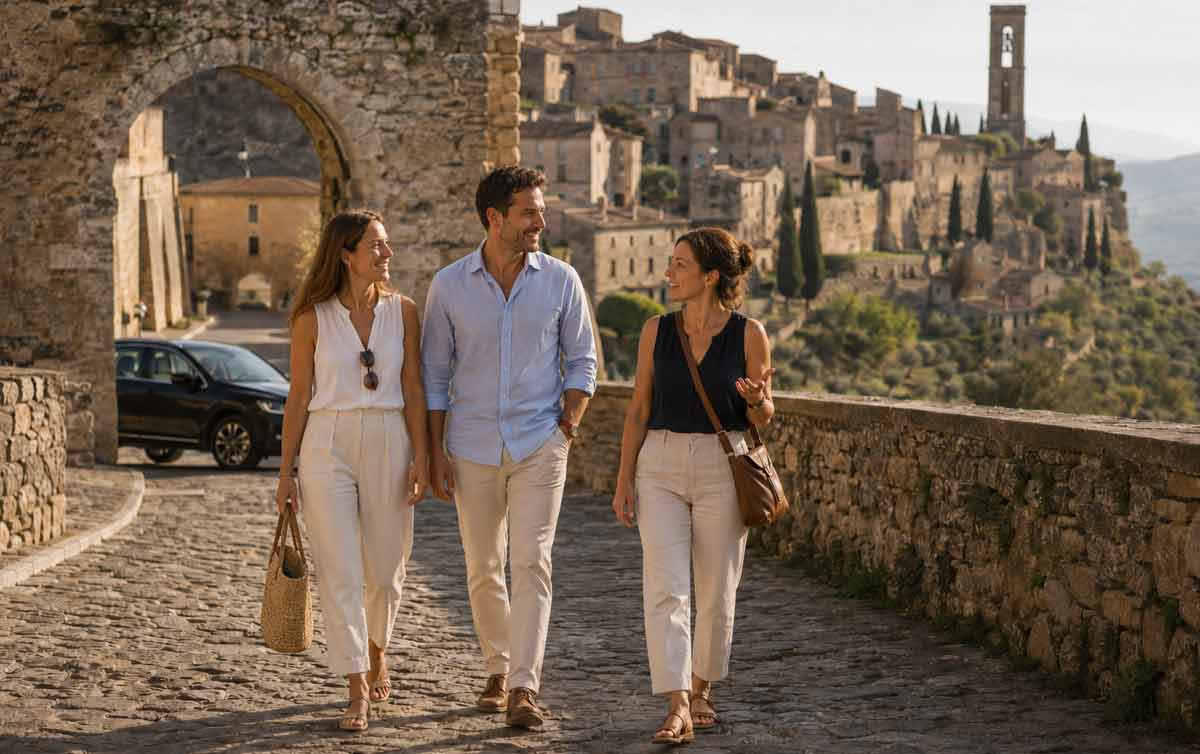
There is a point at which planning everything yourself stops adding freedom and starts adding friction.
If you want to visit several medieval towns in Spain, especially across rural areas or different regions, private travel can make the journey considerably simpler while still keeping the experience flexible and personal.
When Private Transportation Makes the Journey Easier
Many of the places in this guide are easier to enjoy when you are not thinking about parking, unfamiliar roads, historic-center access or how long the next drive will take.
Private transportation also gives you more freedom to adjust the day. A longer lunch, an extra viewpoint or a slower walk does not have to become a problem simply because the schedule was too tight.
When a Local Guide Adds More Than Directions
A good guide should do more than lead you from one monument to another. Local history, cultural context and practical knowledge can help you understand why a town looks the way it does, what is worth your time and what can safely be skipped.
That is particularly valuable in places where the best experience is not always the most obvious attraction.
Day Tours From Zaragoza or Longer Private Journeys Across Spain
Rutica41 is based in Zaragoza, with especially strong knowledge of Aragón, but private journeys can also be designed across other regions of Spain.
Depending on your available time, that might mean a private day tour from Zaragoza or a longer journey connecting medieval towns, landscapes, food and local culture at a pace that suits you.
For more details about how this type of travel works, visit our private tours of Spain.
Want to explore medieval Spain without turning the trip into a logistics exercise?
Frequently Asked Questions About Medieval Towns in Spain
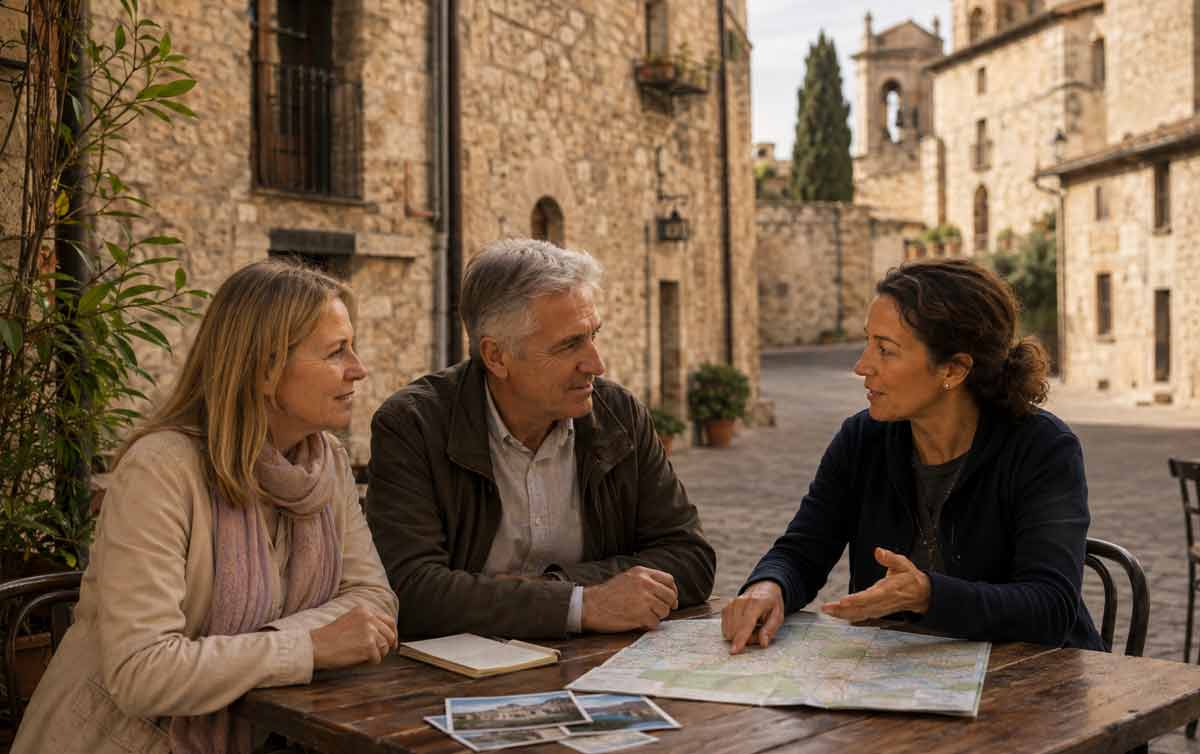
If you are still comparing destinations, these are some of the most common questions travelers have before building a route through medieval Spain.
What are the best medieval towns in Spain?
Some of the best medieval towns in Spain include Albarracín, Alquézar, Aínsa, Laguardia, Olite, Hondarribia, Santillana del Mar, Besalú and Pedraza. The right choice depends on what you value most. Albarracín is particularly strong for atmosphere, Laguardia for wine, Olite for its royal palace and Alquézar for combining medieval heritage with dramatic natural scenery.
What are the best medieval villages in Spain?
If you prefer smaller historic settlements, Peratallada, Pals, Alquézar and Aínsa are excellent places to start. Each offers a different experience, from intimate stone streets to Pyrenean scenery. The distinction between a “town” and a “village” is less important for travelers than the atmosphere, walking conditions and how naturally the destination fits into the rest of the journey.
What is the most beautiful medieval town in Spain?
There is no objective winner, but Albarracín is one of the strongest candidates. Its reddish buildings, fortified walls, irregular medieval streets and dramatic position above the Guadalaviar River create a setting unlike almost anywhere else in Spain. If your idea of beauty includes wine country, mountains or the coast, however, Laguardia, Aínsa or Hondarribia may appeal to you more.
What are the best medieval towns in Aragón?
For a first journey through Aragón, consider Albarracín, Alquézar, Aínsa, Daroca, Teruel and Sos del Rey Católico. Together they show how varied the region can be: fortified towns, Mudéjar architecture, Pyrenean landscapes, canyon scenery and quieter historic centers. You do not need to visit all six. Choosing the right two or three usually creates a better trip.
What are the best medieval towns in northern Spain?
Laguardia, Olite, Hondarribia, Santillana del Mar and Potes are particularly rewarding. Laguardia combines wine and medieval walls, Olite has an extraordinary royal palace, Hondarribia adds Basque food and coastal scenery, Santillana offers a classic historic-town experience, and Potes works especially well when you want to combine heritage with the mountains of Cantabria.
Which medieval towns in Spain are less crowded?
Daroca and Sos del Rey Católico are good places to consider if quieter exploration is a priority. Some better-known destinations can also feel surprisingly peaceful when visited outside weekends, peak holiday periods or the busiest hours of the day. Crowd levels change considerably by season, so timing can matter almost as much as the destination itself.
Which medieval towns are easier to explore at a relaxed pace?
Compact historic centers such as Olite, Peratallada and Pedraza can work particularly well for a slower visit. That does not mean they are completely flat or fully accessible: cobblestones and uneven surfaces are common in historic Spain. The advantage is that you can see a meaningful part of the town without needing to complete long walks or extensive climbs.
How much walking should you expect in Spain’s medieval towns?
Expect cobblestones, slopes and uneven paving in many destinations. Albarracín and Sos del Rey Católico involve more changes in level, while optional activities such as the canyon route at Alquézar require considerably more effort. A good itinerary separates the essential historic visit from optional walls, viewpoints and longer walks so the day can be adapted to your preferred pace.
Can you visit Albarracín and Teruel in one day?
Yes, Albarracín and Teruel can be combined in the same day if you are traveling by car or private transport. The question is whether you should rush them. Albarracín rewards slow exploration, while Teruel deserves time for its Mudéjar architecture and historic center. If both are important to you, allowing a full day — or more — creates a much better experience.
What is the best medieval town near Zaragoza?
Daroca is one of the most practical choices for a medieval day trip from Zaragoza, especially if you are interested in fortified walls and a quieter historic atmosphere. Sos del Rey Católico offers an even more concentrated medieval setting but requires a different route. The best choice depends on how much driving you want and what kind of experience matters most.
Do you need a car to visit medieval towns in Spain?
Not for every destination, but a car or private transportation makes a multi-town journey considerably easier. Many of Spain’s most interesting medieval towns are in rural areas where public transport connections may be limited or indirect. Having your own transport also gives you more control over lunch stops, viewpoints, wineries and how long you stay in each place.
What is the best time of year to visit medieval towns in Spain?
Spring and autumn are excellent periods for many medieval-town routes because temperatures can be more comfortable for walking and popular destinations may feel less intense than in peak summer. Summer is still possible, but earlier starts and longer midday breaks can be useful in inland Spain. Winter can be atmospheric, although weather and opening hours deserve more attention.
Can Rutica41 organize a private multi-day trip through medieval Spain?
Yes. Rutica41 is based in Zaragoza and has particularly strong local knowledge of Aragón, but private journeys can also be designed through other regions of Spain. A longer route can combine medieval towns with food, wine, landscapes and cultural stops while taking into account your available days and preferred walking pace. You can learn more about our private tours of Spain.
Discover Medieval Spain at Your Own Pace
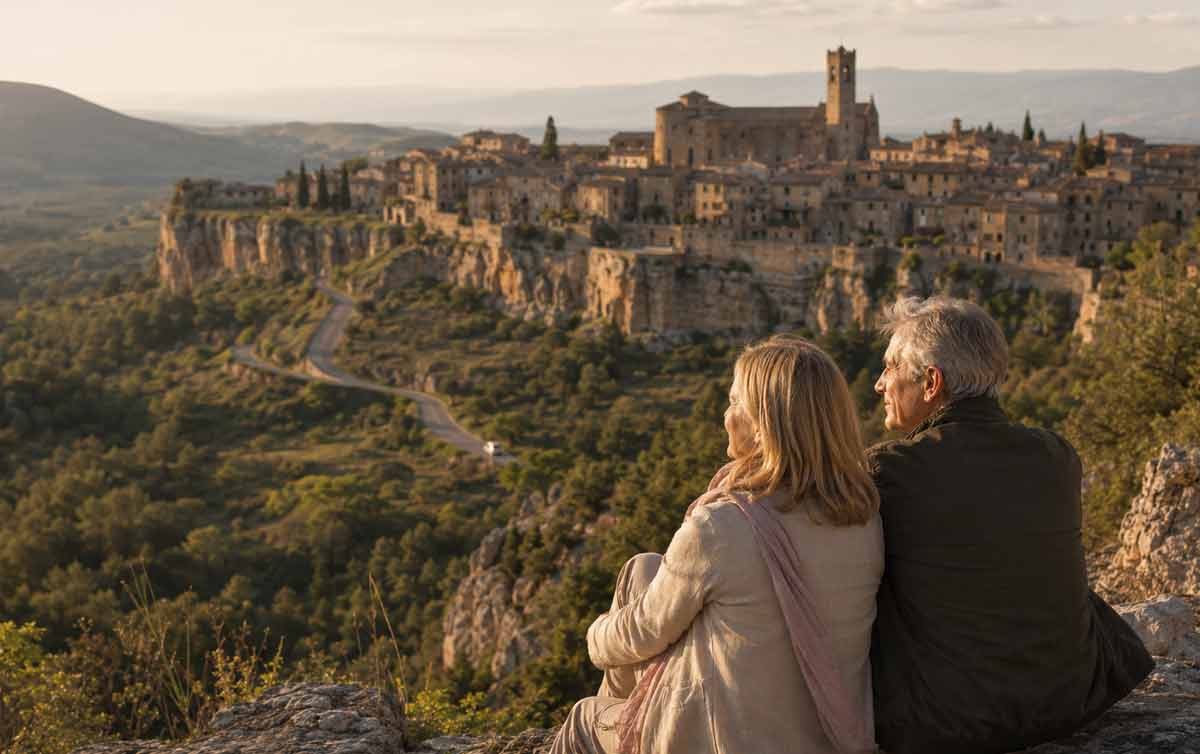
The best journey through medieval Spain is not the one that includes the greatest number of towns.
It is the one where you have enough time to notice the details: a quiet square before the day gets busy, a castle wall above the landscape, a long regional lunch or a road that becomes memorable simply because you were not rushing to the next stop.
Albarracín may be the place you remember most. Or it might be a glass of wine overlooking the vineyards of Laguardia, the stone streets of Peratallada, the mountains beyond Aínsa or a town you had barely heard of before arriving.
That is the advantage of traveling more slowly. You stop asking how many places you can fit into the trip and start choosing the ones that are genuinely worth your time.
If that is how you would like to experience Spain, Rutica41 can help you design a private journey around your interests, preferred pace and available days, whether that means exploring Aragón from Zaragoza or connecting several regions on a longer trip.